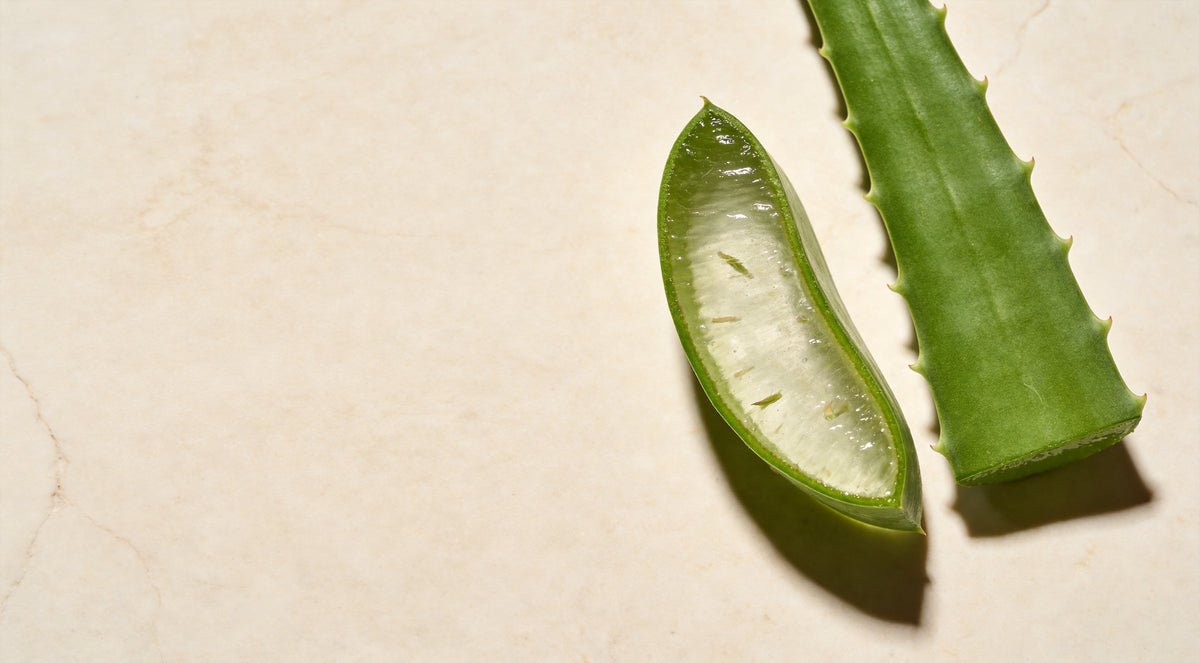
Turn over any moisturiser and read the first ingredient. Most of the time it says Aqua, which is water. In many of our formulas, something else takes that place: organic not-from-concentrate aloe vera juice. Here is what that is, what it can do for your skin – and what it can't.
What comes first, counts.
The ingredient list on cosmetics, the INCI, follows a fixed rule: everything above one percent is listed in descending order of quantity. So the first ingredient is the one with the largest share.
In classic creams, that is almost always water. A typical emulsion is largely made up of its water phase, often 60 to 80 percent. Water isn't a bad thing. But it is a carrier, not a care ingredient.
For many of our formulas we asked ourselves: what if the carrier brought something with it?
What is not-from-concentrate aloe vera juice?
Not from concentrate means the juice is obtained from the gel inside the aloe leaves and processed the way it comes from the plant. It is not reconstituted from powder or concentrate with added water.
In the INCI you'll find it as Aloe Barbadensis Leaf Juice. The asterisk next to it marks organic farming in our lists.
For comparison: when aloe is used as a powder, the INCI usually starts with Aqua and lists Aloe Barbadensis Leaf Juice Powder far down. The name sounds similar, the formula is a different one.
That's how much water the gel of the aloe vera plant naturally contains. The remaining percent makes the difference.
To be honest: aloe isn't "water-free".
This is part of the truth: aloe vera gel itself is around 99 percent water. A formula built on aloe is therefore not "water-free", and we don't call it that.
The difference lies in the remaining percent. It contains more than 75 compounds from the plant:
- Polysaccharides, above all acemannan. They make up more than half of the dry matter and can bind water.
- Amino acids and enzymes.
- Vitamins such as vitamin C, B vitamins and beta-carotene.
- Minerals such as calcium, potassium and zinc.
Where plain water usually forms the base, aloe juice brings these plant compounds along. That's what matters to us.
What aloe can do for your skin – and what it can't.
Aloe vera is one of the best-known plants in skincare and has been widely researched. Its polysaccharides bind moisture. In studies, skin hydration was measurably higher after applying aloe gel. A soothing effect on reddened skin was observed as well.
But we don't want to promise anything research doesn't support:
- Most studies are small and short.
- In one study, pure aloe solutions even had a slightly drying effect after repeated use. So aloe alone isn't complete care.
- Aloe doesn't replace treatment for medical skin conditions.
That's why aloe never stands alone in our formulas. In the creams it is followed by glycerin, plant butters and oils that hold moisture and keep skin supple. In the serums, multi-weight hyaluronic acid joins in.
Where you'll find aloe juice in our range.
Whether a formula is built on aloe is shown in the INCI on every product page. An overview:
Aloe listed first, no Aqua in the INCI
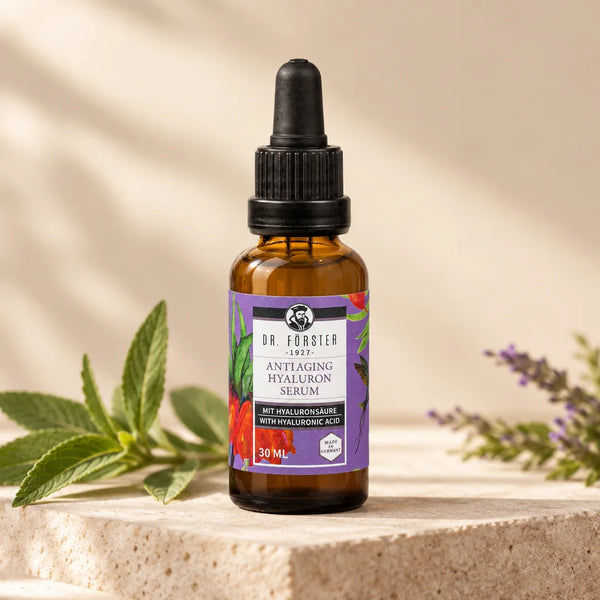
- Anti-Aging Hyaluronic Serum
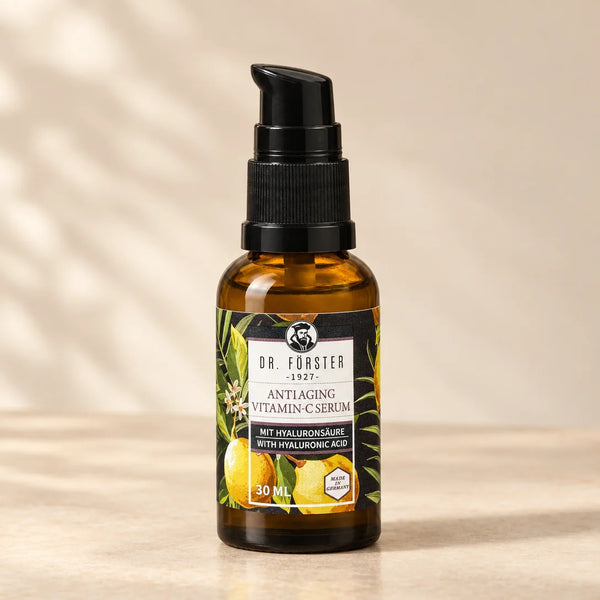
- Anti-Aging Vitamin C Serum
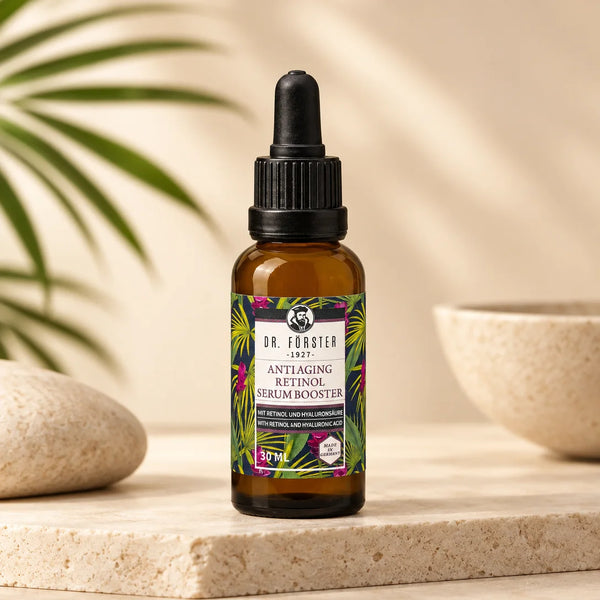
- Anti-Aging Retinol Serum Booster
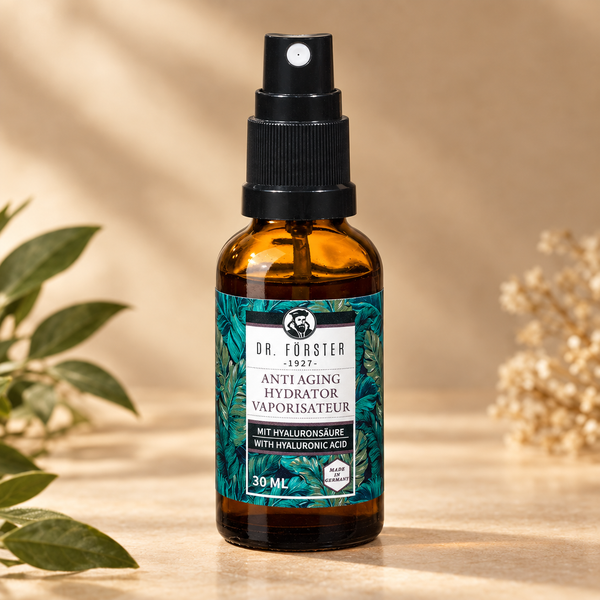
- Anti-Aging Hydrating Mist
Aloe instead of water as the main ingredient
- Anti-Aging Day Cream and Day Cream SPF 10
- Anti-Aging Night Cream
- Anti-Aging 24-Hour Cream
- Anti-Aging Body Lotion
How to read an INCI yourself.
- Look at the first three ingredients. They usually make up most of the formula.
- Check the exact name. Aloe Barbadensis Leaf Juice near the top is not the same as Leaf Juice Powder near the bottom.
- Question percentages on the front. "99% aloe" can refer to a reconstituted raw material. The INCI shows where aloe really stands.
In short: in many formulas, we replace plain water with organic not-from-concentrate aloe vera juice. It is mostly water itself, but it brings the plant's polysaccharides, amino acids, vitamins and minerals along. It's not a miracle ingredient. It's a better base.
Sources
- Chelu M. et al. (2023): Aloe vera-Based Hydrogels for Wound Healing. Gels 9(7):539. PMC10379830
- Fox L. T. et al. (2014): In vivo skin hydration and anti-erythema effects of Aloe vera, Aloe ferox and Aloe marlothii gel materials. Pharmacognosy Magazine 10(Suppl 2):S392–S403. PubMed 24991119
- Guo X., Mei N. (2016): Aloe vera: A review of toxicity and adverse clinical effects. J Environ Sci Health C. PMC6349368
- International Aloe Science Council: Aloe FAQs. iasc.org
- Regulation (EC) No 1223/2009 on cosmetic products, Art. 19 (labelling of ingredients).